It's not practice — it's Playtime.
What's inside Maestro Academy
Games that train real ears, a step-by-step path from "what's a staff?" to sight-reading Bach, sheet music that engraves and plays in the browser, and classrooms that battle live. Here's the tour — with two working exhibits you can play right on this page.
Who gets in
That's the whole policy: classrooms and veterans ride free; solo learners come in through the Playtime app — there's nothing to buy or create on this site.
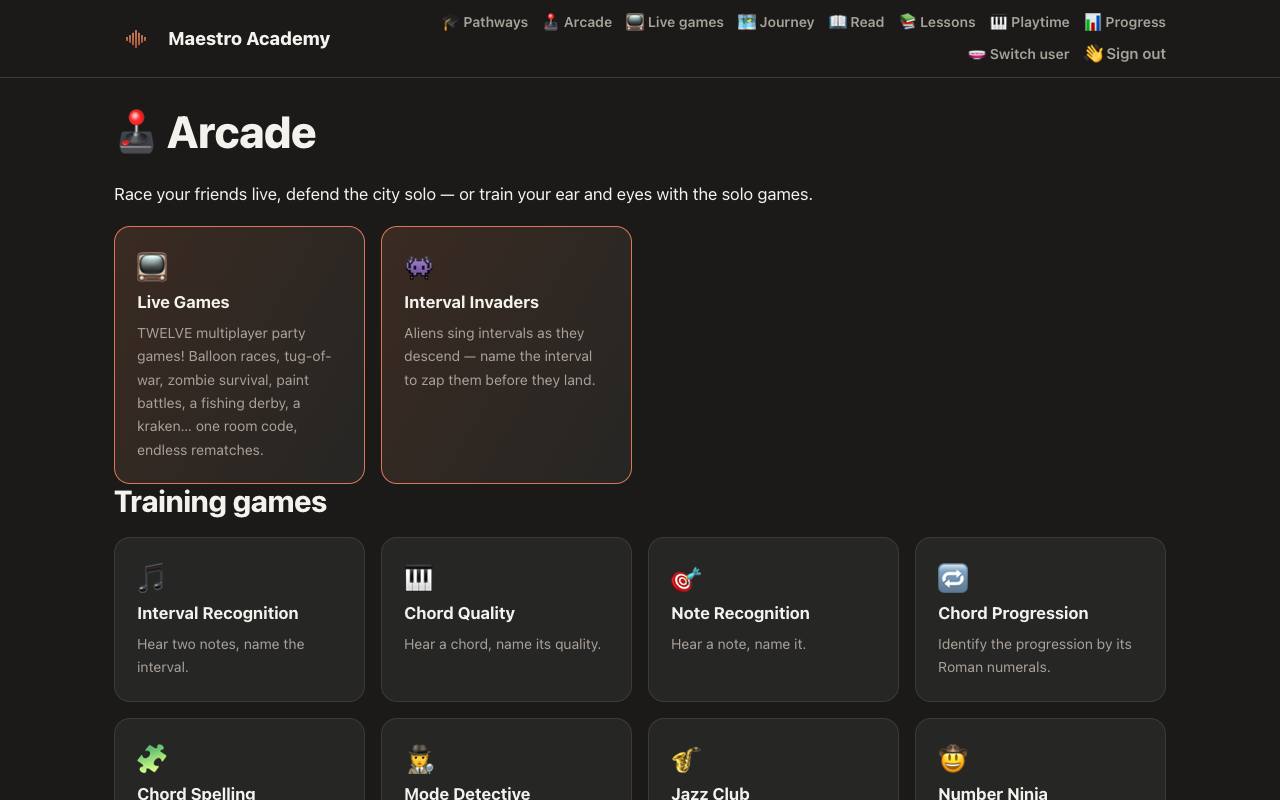
🕹️ The Arcade — forty-plus games that train real skills
Ear training (intervals, chords, modes, jazz voicings), rhythm games graded to the millisecond, staff-reading races, and Interval Invaders when it's time to defend the city. Every round pays XP, feeds your streak, and quietly notes which skills need work.
🎸 Instrument studios — your instrument's own room
Piano, guitar, bass, ukulele, drums and voice each get a studio: interactive keyboards, fretboards and chord shapes, a synthesized drum kit, warm-ups and range finding for singers — plus lessons written for that instrument and a graded chapter in the Reading Journey. Every scale worth knowing lights up in the Scale Lab, on a keyboard and your own neck. Got a MIDI keyboard? Plug it in and play the widgets with real keys.
☀️ Major
The scale every other scale is described against.
🌙 Minor
Three of them, and the difference is one or two notes.
🖐️ Pentatonic
Five notes. Fewer ways to be wrong, and it's why they're everywhere.
🎷 Blues
The pentatonic with one extra note that changes the whole genre.
🌗 Modes
Same seven notes, seven different homes — they have their own room.
🌗Ride the brightness ladder Ionian, Dorian, Phrygian, Lydian, Mixolydian, Aeolian, Locrian — seven homes in one set of notes.🌫️ Whole Tone
Six notes, all a step apart. No home to return to.
🕷️ Diminished
Eight notes that repeat every minor third — one shape, four keys.
🎹 Chromatic
Every note there is. Not a colour so much as a way of getting somewhere.
Pick a root and a scale. Every one of them lights up the keyboard, plays on demand, and tells you the chord it was born to sit over. 🪜
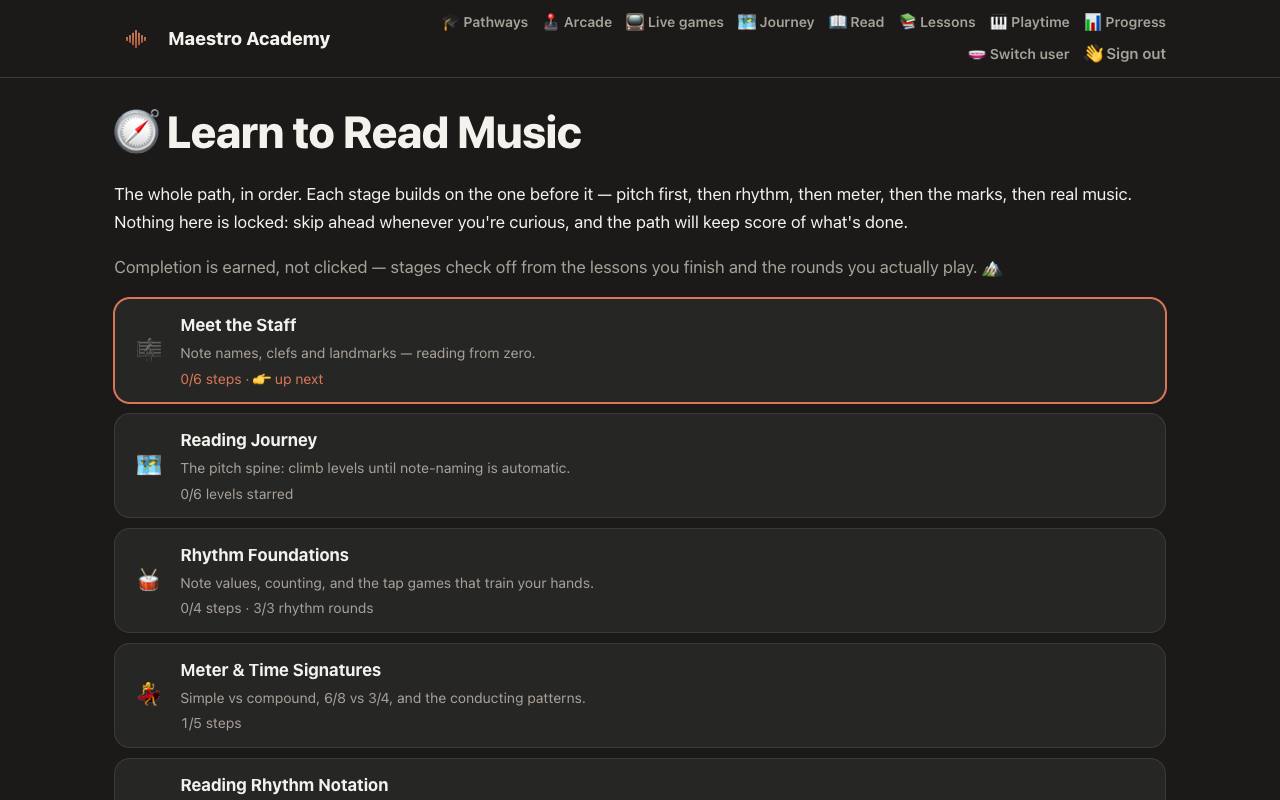
📖 Learn to Read Music — the whole path, in order
Eight stages from note names to sight-reading Bach: the staff, the Reading Journey, rhythm games, meter, notation, every symbol on the page, the Score Lab, and three walked-through Bach excerpts. Stages check themselves off from what you actually do — completion is earned, not clicked.
💃 Live exhibit: the Meter Explorer
This one you don't have to imagine — it's running right here. Pick a meter, press Conduct it, and a baton traces the real conducting pattern while the click accents the bar. Then play the duel at the bottom: six identical eighth notes as a waltz, then as a jig. Same notes. Different dance. That's what the Academy's widgets are like — every one a working instrument, not a diagram.
1234
Four quarter-note beats: STRONG–weak–medium–weak.
Common time — most of the radio lives here. Down, in, out, up; beat 3 gets a half-size accent.
Both buttons play the exact same eighth-note stream at the same speed. Only the accents move — 2+2+2 makes a waltz, 3+3 makes a jig. Listen with your feet.
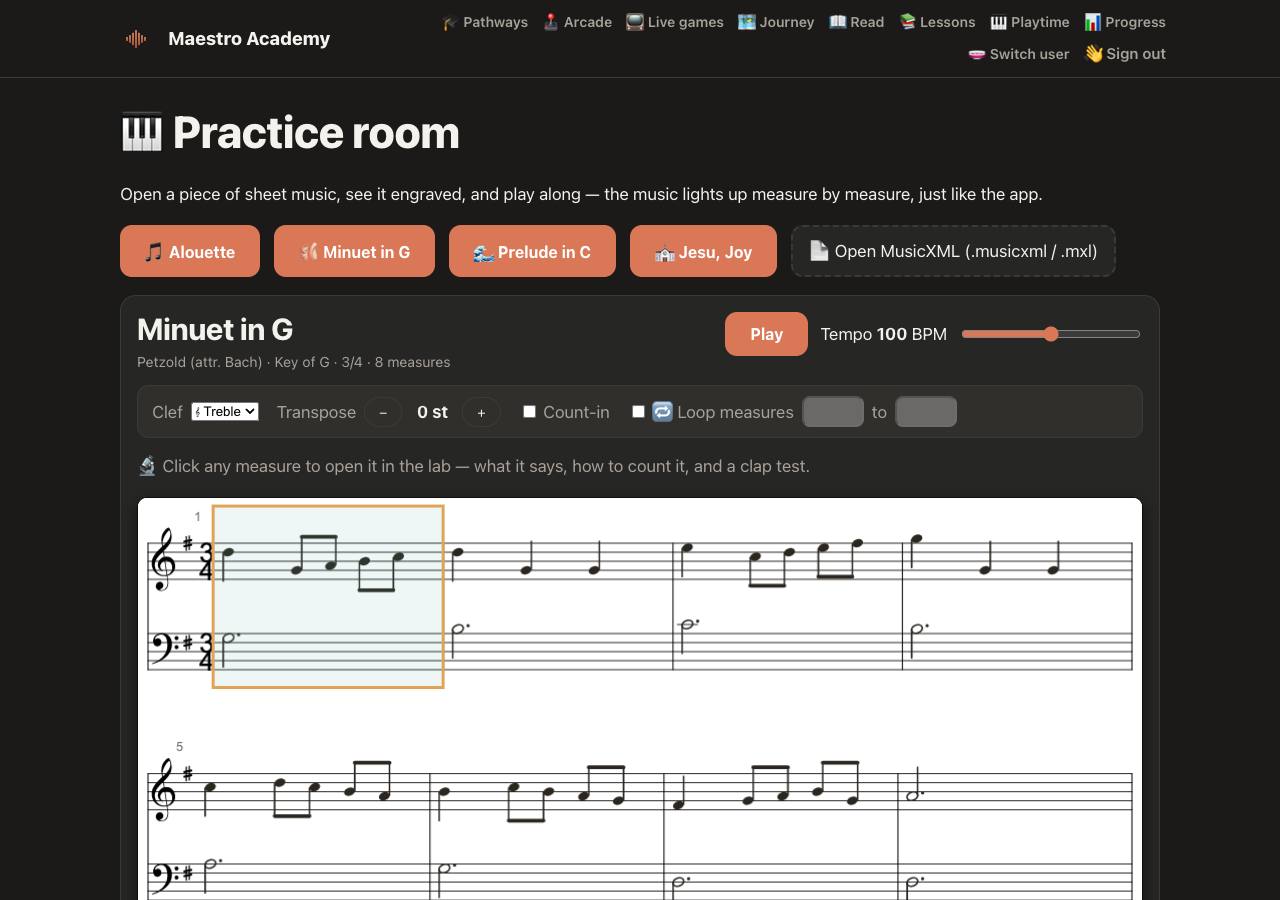
🔬 The Score Lab — real sheet music, dissected
Open built-in pieces (Alouette, the Minuet in G, Bach's Prelude in C) or any MusicXML file. It engraves in the browser, plays with a follow-along glow, loops the hard bars at half speed — and when you click a measure, the lab explains it: every note's name and count, the harmony it leans on, and a clap test that grades your rhythm to the millisecond.
🧭 Live exhibit: the Circle of Fifths
Click any key — hear its chord and scale, see its signature and relative minor. Twelve stops, one perfect fifth apart, and a couple of hidden surprises for the thorough. The theory pages are full of instruments like this: the circle, an interval lab, a mode mixer, a chord stacker, a groove builder, a symbol lab.
Tap any key to hear it — chord first, then the scale walking home. 🎧
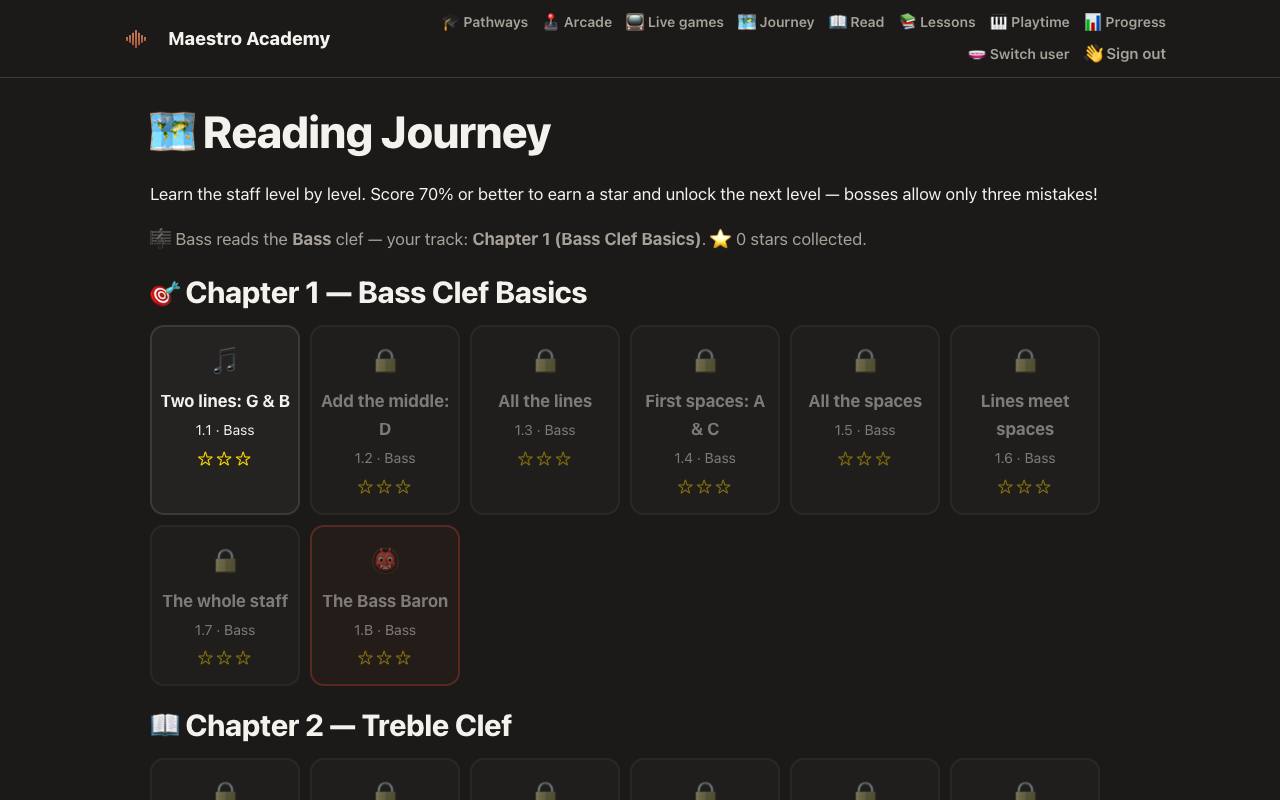
🗺️ The Reading Journey — 90+ levels, 14 chapters, bosses
Staff reading as a proper campaign: learn a few notes, drill them, beat the boss, unlock the next stretch of the staff. Rhythm chapters train your tapping against a real clock, and your instrument gets its own graded chapter — the guitar neck, the drum kit, singing in tune. Stars for accuracy, and a map that makes the grind feel like progress because it is.
📊 Progress that tells the truth
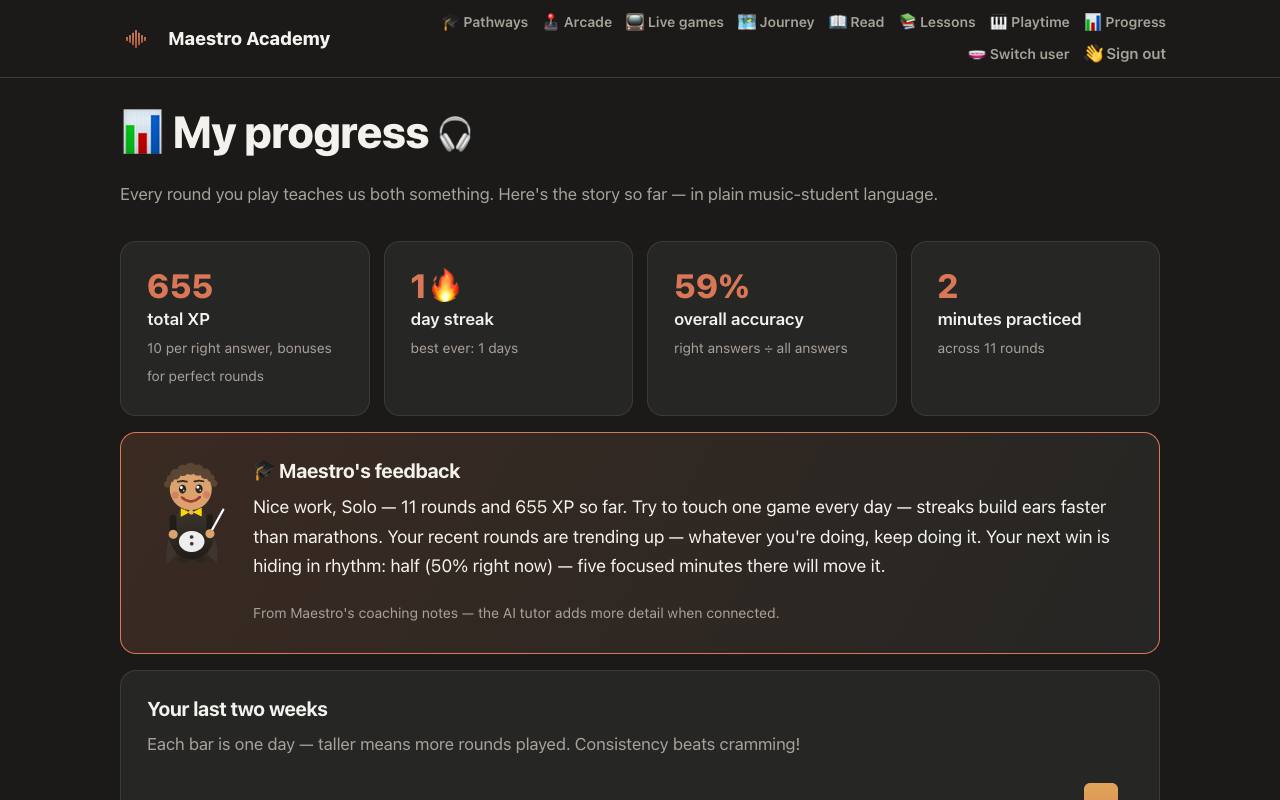
XP, streaks, per-game accuracy, and a skill spotlight that names exactly what to practice next — computed from every round you play, and narrated in plain music-student language by the Maestro's coaching notes.
🎒 Classrooms that battle live
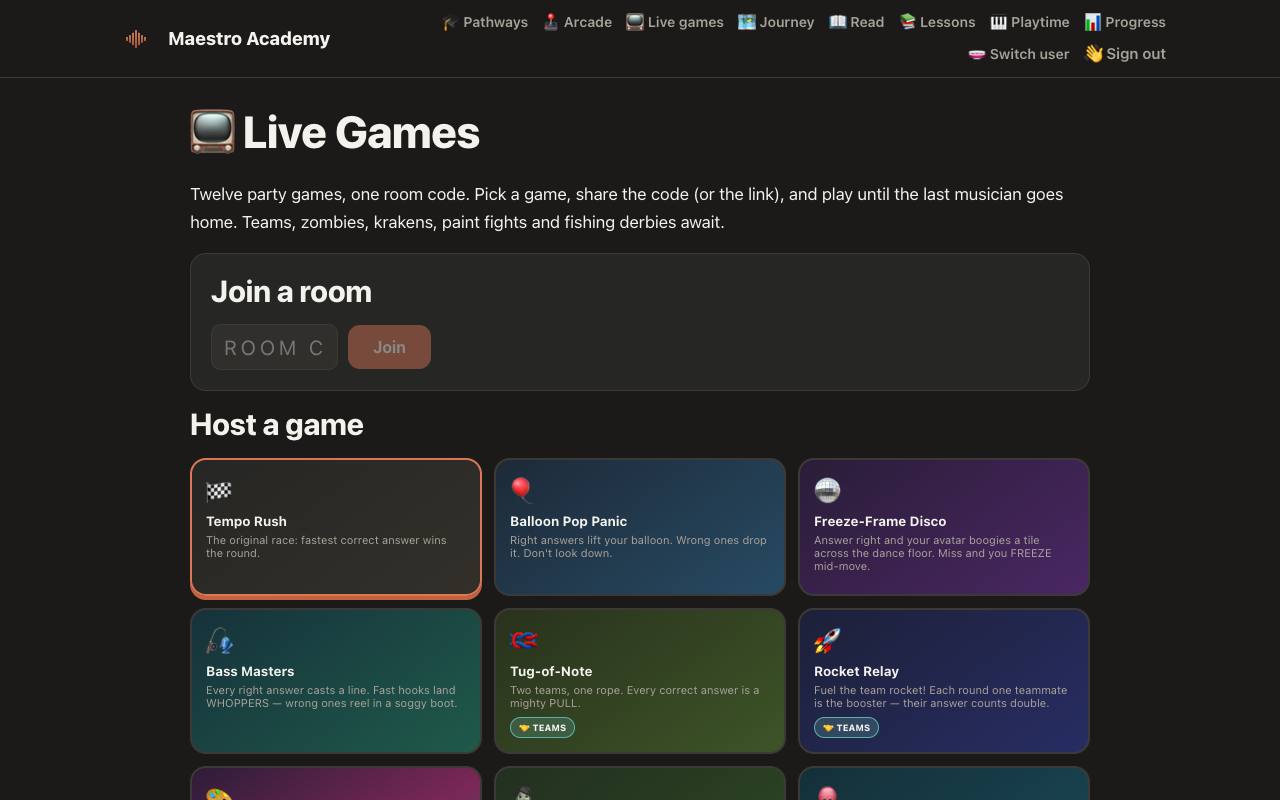
Teachers get classes with join codes, assignments, a quiz studio, grading, and twelve live multiplayer party games — balloon races, tug-of-war, zombie survival, a kraken — one room code, endless rematches. Per-student progress comes along for free.
🤖 Two AI characters: Maestro teaches, Miles assists
Solo learners get Maestro as their teacher — weekly assignments from the built-in curriculum, feedback on every quiz, a progress report — included with the subscription that got them in. Miles, the Teacher's Assistant chat, answers questions, builds and grades quizzes and goes deeper on any lesson; Miles spends your own Playtime AI allowance, so Miles chat needs a subscribed Playtime account for everyone, teachers included. School accounts and veterans get the subscription discounted.